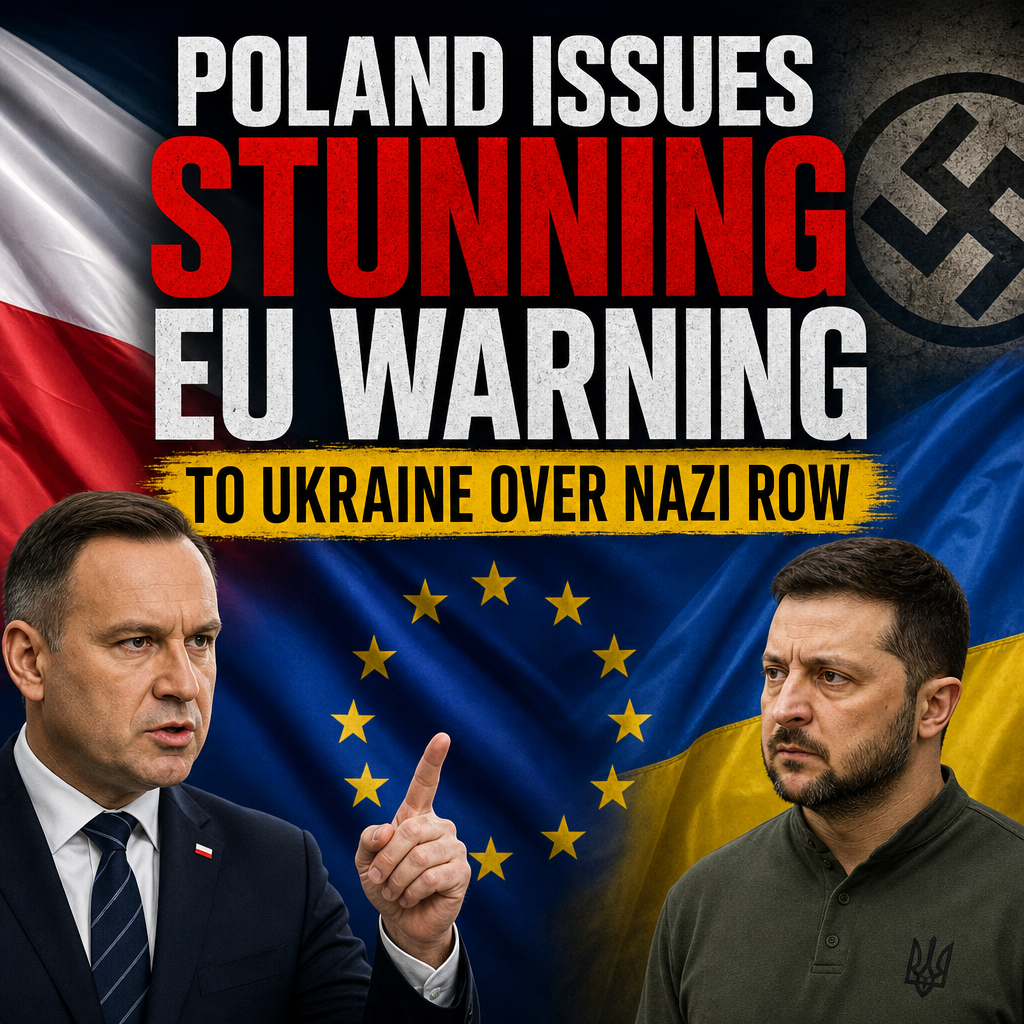
Poland Issues Stunning EU Warning to Ukraine Over Nazi Row


Poland’s warning to Ukraine over a Nazi row has added a sharp political edge to Kyiv’s long-running effort to keep its European Union path on track, exposing how wartime symbolism, historical memory, and enlargement politics can collide at the worst possible moment. What might otherwise have been a niche dispute about a controversial public figure has turned into something much bigger: a test of how far Ukraine can go in building support inside Europe while still under invasion, and how much patience its neighbors have for arguments that touch raw nerves in their own history.
At the center of the controversy is the legacy of Stepan Bandera, a deeply divisive nationalist leader from the mid-20th century whose followers are credited by some Ukrainians with resistance to Soviet domination, but associated by others with extremism and collaborationist violence during World War II. That historical split matters because Poland, Ukraine’s key regional ally and one of its loudest supporters in the EU, has repeatedly shown that it will not treat the issue as a matter of symbolism alone. For Warsaw, the concern is not only historical accuracy but also the political message sent to Polish voters and EU partners when contentious nationalist icons are elevated.



Why Poland’s warning matters for Ukraine’s EU path
The immediate significance of the Polish warning is that it comes at a moment when Ukraine is trying to present itself as a credible candidate for closer integration with Europe. EU accession is not only about reforms, anti-corruption measures, and rule-of-law benchmarks; it is also about political trust. A country seeking membership needs the support of existing members, and Poland has been one of Ukraine’s most important advocates since Russia’s full-scale invasion began.
That is why even a symbolic row can carry disproportionate weight. If Warsaw signals that it is prepared to make Ukraine’s EU ambitions harder over nationalist controversies, that sends a message far beyond the historical debate itself. It suggests that Poland is willing to use its leverage to defend its own red lines, even while backing Ukraine militarily and diplomatically.




From one point of view, this is a reasonable stance. Supporters of Poland’s position argue that EU enlargement cannot be built on selective memory. They say countries aspiring to join the bloc should be sensitive to neighbors that suffered directly from the wartime violence and should avoid official or semi-official gestures that appear to rehabilitate figures associated with fascism or ethnic cleansing. In that reading, the warning is not anti-Ukrainian; it is pro-European in the sense that it demands a common standard on historical responsibility.
But there is another side to the story. Many Ukrainians see these disputes as part of a broader struggle to define national identity after decades of Russian and Soviet domination. In that view, Bandera and related nationalist symbols are not necessarily endorsements of Nazi ideology, but part of a complicated anti-imperial narrative. Ukraine’s defenders often argue that Russia has weaponized this history to discredit the country internationally, flattening a messy past into propaganda-friendly labels.
A dispute shaped by war, memory, and politics
The timing of the row is important. Since Russia’s invasion, Ukraine has depended on the goodwill of European governments more than ever. That has made every diplomatic misstep more costly. It also means its officials and public figures are under pressure to balance domestic historical narratives against the expectations of foreign allies.
Sky News coverage of the wider war has repeatedly shown how European governments are trying to walk a narrow line: supporting Ukraine robustly while managing public opinion at home, economic pressure, and political fatigue. In that environment, anything that can be framed as extremism becomes politically toxic, especially in countries where far-right movements are already a live issue. Poland knows this well. Its own politics have been shaped by debates over nationalism, sovereignty, and historical grievance, which makes it especially sensitive to anything resembling ideological rehabilitation.
Al Jazeera’s broader coverage of the conflict has also highlighted how the war continues to reshape alliances, identities, and regional politics. From that angle, the Poland-Ukraine dispute is less an isolated incident than a reminder that Europe’s response to the war is not purely military or economic. It is also moral and historical. European leaders are not just asking whether Ukraine can defend itself; they are asking what kind of state will emerge if it wins.
That creates a difficult balancing act for Kyiv. It can scarcely afford to alienate Poland, one of its most important transit routes, diplomatic supporters, and advocates inside the EU. Yet it also cannot easily surrender control over how it tells its own national story. That tension helps explain why such rows flare up repeatedly: both sides believe they are defending something fundamental.
What the sources agree on — and where they diverge
There is broad agreement across the reporting that this is not merely a symbolic spat. The dispute touches real political leverage, with Poland able to affect the tone and pace of EU discussions. There is also a shared recognition that historical memory in Eastern Europe remains highly charged and deeply political.
The disagreement lies in interpretation:
– Poland’s reading: certain nationalist symbols cross a line and risk normalizing extremist associations.
– Ukraine’s reading: critics are oversimplifying a complex past and ignoring the country’s struggle against Russian domination.
– The wider European view: support for Ukraine remains strong, but accession politics require restraint, credibility, and sensitivity to neighbors’ historical wounds.
The most careful conclusion is that both sides have something to lose. Poland risks appearing to undermine a partner under enormous pressure if it escalates too aggressively. Ukraine risks giving opponents of enlargement fresh ammunition if it fails to distance itself from figures or imagery that many Europeans associate with the darkest parts of 20th-century history.
The bigger picture
This row is unlikely to decide Ukraine’s EU future on its own, but it does reveal the fragility of the political coalition behind that future. Support for Ukraine in Europe is real, yet it is not unconditional. It rests on shared values, practical interests, and a degree of emotional solidarity that can be strained by historical disputes.
In that sense, Poland’s warning is both a reminder and a message. The reminder is that history still matters in Europe, especially in places where war and occupation are not distant memories but living family histories. The message is that Ukraine’s road to Europe will be judged not only by battlefield resilience and reform promises, but also by how carefully it handles the symbols and narratives that shape trust.
The controversy may fade, but the underlying dilemma will not. Ukraine wants the West to see it as a modern democratic state fighting for survival. Its neighbors want reassurance that in doing so, it will not gloss over the painful parts of its past. That tension is not easy to resolve, and for now, it remains one of the more uncomfortable truths of Europe’s war-era politics.